Ogres Marks 3, 3-B, 5 and 7

Ogres Marks 3, 3-B, 5 and 7
The Mark 7's advanced cloaking makes it impossible to keep in focus

Tuesday, 6 January 2015

New Units for Ogre!


I created these units using a combination of Cobb’s new unit formula found here and common sense. Where fractions were involved values of costs were rounded up. These units have not for the most part been play tested and are most likely unbalanced, some are alternate versions of official or fan made units. The Laser units were posted in a previous update but are included for completeness.

Jump Jet Infantry (JJINF)
-Represent battlesuit equipped infantry with Jets capable of higher longer flight making them even more mobile than regular infantry.
Attack: 1/2/3
Defense: 1/2/3
Range: 2"
Movement: 3"/2"
Cost: 4/8/12
-May give up second move to fly up, in game terms this increases their weapon range by 1" until end of turn.
-Move as GEV unless they move only 2” and none in the second phase in which case they may move as INF, in this turn they may still add 1” to their range for flying up.

Archaic Super Heavy Tank (ASHVY)
-Represents what a super heavy tank would be like if it was built in the very near future and up gunned as the other archaic units.
Attack: 4(2+2)
Defense: 3
Range: 3"
Movement: 3"
Cost: 6
-1 AP weapon.
-Moves as heavy tank.

Alternate Super Heavy Tank [Single Gun] (SHVY)
An alternate model of the super heavy swapping out the two smaller guns for one main longer range gun, used for tank and ogre killing as the strike range is enormous, use with caution.
Attack: 6
Defense: 5
Range: 8"
Movement: 6"
Cost: 16
-2 AP weapons

Mobile Repair Vehicle (MRV)
Represents a rear area repair vehicle with robotic arms and a crew of engineers.
Attack: 0
Defense: 1
Range: 1"
Movement: 4"
Cost: N/A (By Scenario)
-May repair vehicles: Disabled vehicles within 1" may be un-disabled automatically.
-A vehicle hulk may be repaired between battles.
-Ogre treads and AP units may be repaired one per turn.

GEV-PC Heavy Assault Vehicle (HGEV-PC)
-Represents a large GEV transport vehicle based on a model my brother has, meant for special scenarios and probably unbalanced.
Attack: 2(1+1)
Defense: 2
Range: 4"
Movement: 6"/4"
cost: 8
-May carry 1-6 units of infantry or 1-8 units of militia.

GEV Assault Drone (GEV-AD)
-Represents the Ogre universes version of the US militaries modern drone units as planes are not used as often this allows fast and easy strikes with no human risk.
Attack: 3
Defense: 1
Range: 4"
Movement: 6"/4"
cost: 5
-(-1) to attack unless within 20" of a friendly ogre or command post
-Ignores D results.

Heavy GEV (HGEV)
-Represents a heavier slower more durable GEV used as less of a skirmisher and more of a frontline combat vehicle.
Attack: 3
Defense: 3
Range: 4"
Movement: 6"/4"
Cost: 8

Crewed Light Artillery (CLA)
-Represents a version of the Light Artillery Drone featuring a crew included to deploy and operate.
Attack Strength: 2
Range: 8 (16")
Defense: 1
Move: 0
Cost: 10
-Assembles or disassembles in 1 turn. The turn after being deployed may fire.
-May be carried in a hovertruck. Loads or unloads in 1 turn.

Alternate Crewed Light Artillery (CLA)
-Represents an alternate version of the above CLA with a higher Attack strength and higher cost.
Attack Strength: 3
Range: 8 (16")
Defense: 1
Move: 0
Cost: 12
-Assembles or disassembles in 1 turn. The turn after being deployed may fire.
-May be carried in a hovertruck. Loads or unloads in 1 turn.

Light Mobile Howitzer (LMHZ)
-Represents a lighter faster cheaper mobile howitzer with a very low attack strength.
Attack: 2
Range: 10"
Defense: 1
Move: 4"
Cost: 5

Fast Mobile Howitzer (FMHZ)
-Represents a faster version of the mobile howitzer with a reduced range, the strike distance is the same but it allows this unit to be better in assaults and worse on defense.
Attack: 6
Range: 10"
Defense: 2
Move: 4"
Cost: 12

Fast Missile Tank (FMSL)
-Represents a missile tank with a lower range and a higher movement used for assaults, the cost has been increased due to the fact that it will be better than a regular missile tank in most situations.
Attack: 2
Range: 6"
Defense: 2
Move: 6"
Cost: 8

Anti-Tank Gun (ATG)
-Represents my idea for what an anti-tank gun would be like in the Ogre universe
Attack: 4
Range: 6"
Defense: 2
Move: 0
Cost: 5
-Assembles or disassembles in 1 turn. The turn after being deployed may fire.
-May be carried in a hovertruck. Loads or unloads in 1 turn.

Mobile Anti-Tank Gun (MATG)
-Represents a mobile version of the above anti-tank gun.
Attack: 4
Range: 6"
Defense: 2
Move: 2”
Cost: 6

Mobile Laser Unit (MLU)
-As discussed in detail in a previous post this unit is my idea of what a rear area mobile missile defense unit would look like in the Ogre universe.
Attack: 1
Range: 60"
Defense: 0
Move: 2"
Cost: N/A (By Scenario)

Re-deployable Laser Unit (RDLU)
-As discussed in detail in a previous post this unit is my idea of what a rear area re-deployable missile defense unit would look like in the Ogre universe.
Attack: 2
Range 120"
Defense: 0
Move: 0
Cost: N/A (By Scenario)
-May be carried by hovertruck.
-Assembles or disassembles in 3 turns, alternatively may assemble or disassembles in 1 turn if engineers are present.

Elite Infantry (EINF)
Represents my idea for what heavily armored and armed battlesuits would be like in the ogre universe, more like mobile weapons platforms than infantry, note stacking does not give the exact same benefits as infantry.
Attack: 2/4/6
Defense: 2/3/4
Range: 3"
Movement: 3"
Cost: 5/10/15
-Remove one squad for every disabled result as usual.

Thursday, 13 March 2014

Ogre universe flavour and new units. Also lasers!


It never made much sense to me that more long range nuclear weapons and aircraft weren't used in the ogre universe other than the obvious complexity it adds and the imbalance to game rules. The official explanation given for the lack of planes was essentially "lasers, that's why" saying that the lasers present were too accurate for planes. As for long range nuclear weapons the explanation given is that strategic nuclear weapons costs were too prohibitive and alternatively that electronic warfare stopped the missiles too well. As for cost, nuclear weapons now are not that expensive for wealthy countries with nuclear power plants to produce in large amounts and I see no reason why this would have changed especially since small nuclear devices are clearly mass produced for the weapons of conventional troops and Ogres in the Ogre Universe and making larger ones should not be more expensive than making several smaller ones. As for electronic warfare although I can see it accounting for some of the lack of long range nuclear weapon use missiles can be launched extremely long distances with minimal electronic guidance systems with our current calculating systems meaning that this cannot be the only explanation.
Here is some Ogre universe flavour that I wrote for the ogre universe to try to explain why more long range nuclear weapons are not used, along with some new unit stats.

Technology Tactics and Logistics of Ground Combat in the late 21st century:
For much of the late 20th and early 21st century no direct conflict waged between any two nuclear armed nations as this would no doubt result in mutual destruction. From this many concluded that large scale world war was a thing of the past.
To combat these problems laser technology, sensor networks and enhanced automated tracking systems were developed, these new systems could detect and disable or destroy most conventional warheads from a significant range. These systems were immediately implemented in a stationary and permanent manner around all sufficiently advanced countries assuring that no long- range nuclear strikes could destroy them. This was done only under scrutiny and mutual agreement by all nuclear capable countries through a series of treaties and agreements. These “Laser Networks” were very reliable and used a redundancy of lasers covering each other’s sector to help insure that if one system failed it would not mean utter destruction. This network was linked together and integrated with a variety of sensor equipment nearly flawlessly.
With strategic nuclear strikes thus limited the problem became how to prevent long distance tactical strikes on advancing armies and spearheads.
The solution was a mobile Laser network of “laser brigades” stretched out behind the main advancing line of conventional troops. These units were far too fragile and slow moving for conventional combat but instead were placed with open line of sight as far toward the front as possible without exposing themselves to combat. This mobile laser network would shoot down any incoming high altitude missiles or planes long before they could strike the advancing spearhead. Although this system proved far less effective than the emplaced laser networks and was much more prone to failure, it provided enough anti-missile and anti-aircraft defenses to mean that with careful planning and logistical deployment conventional troops could advance at a fairly high speed into enemy territory without being massacred.
This tactic along with the invention of BPC armor brought with it the need for short range low altitude tactical nuclear devices mounted on conventional units. Specialized cruise missiles were developed that could sometimes, in barrages, make it through these mobile networks.
These missiles had thin layers of BPC, semi-intelligent navigational systems, sensor jammers as well as their own anti-missile lasers. Because of this they were high cost, but did not always work and were rarely seen on the battlefield with any meaningful frequency.
Although all major and minor powers kept a relatively small standing garrison of jet or VTOL fighters and bombers and even some helicopters, they rarely saw combat against any but the least advanced forces in the last war, standing by only to exploit a tactical opportunity or to counter one.
This need for a defensive laser network meant that assaults were limited to within the range of the mobile laser networks and made for a very slow almost trench like warfare. This was characterized by quick offensive thrusts into enemy territory followed by a slow reorganization as the laser network moved forward to consolidate the gains.
There were some notable exceptions to these tactics. Often forces invading small countries without a nuclear presence would move ahead of their laser networks. Ogres would sometimes act outside this network to make surprise raids on coastal areas and behind enemy lines, relying on sensor jamming fields and disorganization to protect them. There were even several cases of particularly daring commanders moving forward with only a token number of laser units, enough to stop any test shots the enemy might fire but not enough to stop a full out barrage of missiles. This tactic was extremely uncommon and often ended in utter disaster but on occasion allowed for much faster assaults than enemy troops had expected.
Rules:
Although these units essentially perform a strategic role and would not be present on most Ogre battlefields at their scale here are my imaginings for mobile and deployable laser units stats. These units could appear on the battlefield for breakthrough scenarios, extended campaigns or just for fun. 
(Note these units have not been play tested)

Mobile Laser Unit
Attack: 1
Range: 60"
Defense: 0
Move: 2"
Cost: N/A (By Scenario)

Re-deployable laser unit
Attack: 2
Range 120"
Defense: 0
Move: 0
Cost: N/A (By Scenario)
-May be carried by hovertruck, assembles or disassembles in 3 turns, alternatively may assemble or disassemble in 1 turn if engineers are present.

Monday, 24 February 2014

Ogre Mark VII "Ogre Killer" Miniature!


North American Combine Ogre Mark VII “Ogre Killer”
Several years ago I heard of the mysterious Mk7 and became very interested in what this behemoth would look like as there are no official images of the Mk7. It was never officially produced by the Combine, although plans were drawn up as the war ended. Steve Jackson posted tentative specifications a few years ago from GURPS Ogre and a fan made a fantastic model shown here off of these plans. Another avid fan produced a great counter for the beast off of the miniatures silhouette shown here. The original load out was:
4xMB (Main Batteries)
12xSB (Secondary Batteries)
4xMR (Missile Racks)
32xIM (Internal Missiles
24xAP (Antipersonnel)
4” Move
96 Tread Units
As shown here in the Steve Jackson Games Forum, and originally in GURPS Ogre.

Later Steve Jackson released the Ogre Miniatures Update found here, in it was a revised stat list for the Mk7 with the following configuration:
4xMB (Main Batteries)
8xSB (Secondary Batteries)
12xM (Missiles)
2xHWZ
24xAP (Antipersonnel)
4” Move
96 Tread Units
-In addition the Mk7 has 24 reloads for the external missiles (reloaded by a ‘LT’ type drone), advanced targeting giving all weapons except for the AP +1” Range and the ability to extend the range by an additional 2” if it sacrifices -1 penalty on attack rolls. It also gets a +1 vs. Cruise missiles.

I have dubbed this version the Mark VII-B (unofficially, I just think its cool). Since it has such a different load out from any other Ogre I couldn’t help but wonder what this version would look like.
With some free time on my hands I decided to start construction on a model for the updated Mk7 configuration.  I decided due to the sheer number of weapon systems and especially due to the large number of external missiles to make my Mk7 have a three body segment design rather than the traditional two bodies.
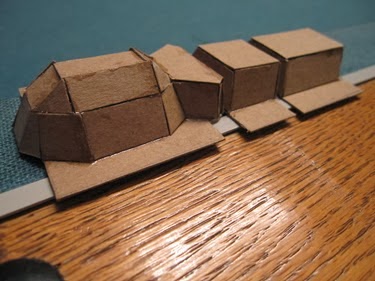
I’d made one other ogre, a Mk3-B before but I rushed the job and made it in about eight hours straight when I was bored one day, here it is next to a Mk3 and a Mk5


Now for the Mark 7!
Total construction time: 1 week on and off work every night.
Materials: thin cardboard, crazy glue, model plane bits, model car bits, nails, bolt ends, a ball bearing, sprue bits and even some parts of an old G.I. Joe vehicle.

Building an Ogre Mk7 from scratch in 9(ish) ‘easy’ steps!:
Stage 1: First I cut geometric shapes out of a thin piece of cardboard with scissors.


Stage 2: I glued the pieces together into a base, and three body segments.


Stage 3: I added treads and lower extensions of the body to the base.


Stage 4: I added a conning tower with ball bearing on top and the bases of all four main batteries.


Stage 5: I added all eight secondary batteries (nails with the tip cut off) and twelve missile casings (cardboard). Engine bits from a model car made the main batteries.


Stage 6: I cut the ends off of twelve nails for the missiles. 


Stage 7: I added detail to the third segment and added both howitzers on the middle section as well as all 24 antipersonnel (6 are on the back beside the 'hatch'). I also added some texture to the area in between the sections with some plastic bits I shaved off of an old G.I. Joe vehicle.


Stage 8: The final stage was to put squares of bug screen over the outsides of the treads for texture.


Sage 9: I quickly threw together a missile reload drone, to accompany the monster.


Complete model: Let me know what you think!


Mk VII Reference Sheet (Stat Graphics courtesy of Ogre Miniatures Update):


Sprayed Black: